
Gas Appliance Certified
We’ve been seeing a lot more heat pump dryers around Vancouver lately, especially in condos and newer homes. They use less energy and don’t need the same venting as…
Repair Snapshot
- Appliance
- Dryer
- Repair Type
- Dryer Repair
- City
- Vancouver
We’ve been seeing a lot more heat pump dryers around Vancouver lately, especially in condos and newer homes. They use less energy and don’t need the same venting as traditional dryers, which is great for smaller spaces. The tradeoff is they usually dry slower, and regular maintenance matters more than people expect. For some households they make perfect sense, but for others, a standard dryer is still the better fit. It really depends on how you do laundry day to day.
How a heat pump dryer works
A standard dryer heats air, pushes it through the drum and sends the damp air outside through a vent. A heat pump dryer works differently. It keeps the same air circulating in a closed loop. The warm, damp air leaves the drum and passes over a cold part of a sealed refrigerant system, where the moisture condenses into water. The dried air is warmed again and goes back into the drum. The water ends up in a tank or goes down a drain, depending on the model.
That closed loop is why these machines don’t need an outside vent, and it’s also why they run at lower temperatures. Lower heat is gentler on many fabrics, but it’s the main reason cycles take longer than people expect. Details differ between brands and models, so your owner’s manual is the best guide for your own machine.
Where they fit well in Vancouver homes
We’re seeing more of them around Vancouver, especially in condos and newer homes. In a condo, running a vent to the outside can be difficult, and a ventless machine solves that problem. They also use less energy than a traditional dryer, which appeals to people who run laundry often.
If your household dries a lot of towels and bulky bedding in a single day, a slower machine may feel like a step backward. If you spread laundry across the week, you might never notice the difference.
Where a standard dryer is still the better fit
A conventional dryer is faster and simpler, and it’s the more forgiving choice for a busy household that runs several big loads in a row. The honest answer is that it depends on how you do laundry day to day, and on the space you have to work with.
How to avoid trouble
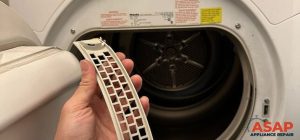
Clean the lint filter after every load, and clean the heat exchanger or condenser the way your manual describes. If your model has a water tank, empty it as the manual says.
Why it matters
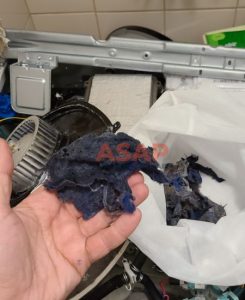
Lint and dust on the heat exchanger restrict airflow, so the dryer has to run longer to get clothes dry. In a machine that already runs slower than a standard dryer, that shows up quickly. Slow drying, damp laundry at the end of a cycle or a musty smell are good reasons to call a technician before a small problem turns into a bigger repair.
ASAP Appliance Repair is based in Surrey and repairs residential dryers across Metro Vancouver, so if you’re weighing up a heat pump model or already own one that isn’t keeping up, we’re happy to take a look.
 Fridge Repair
 Dishwasher
 Washer Repair
 Dryer
Dryer Oven Repair
 Stove Repair