
OEM vs Aftermarket Appliance Parts: What Repair Techs Actually Use
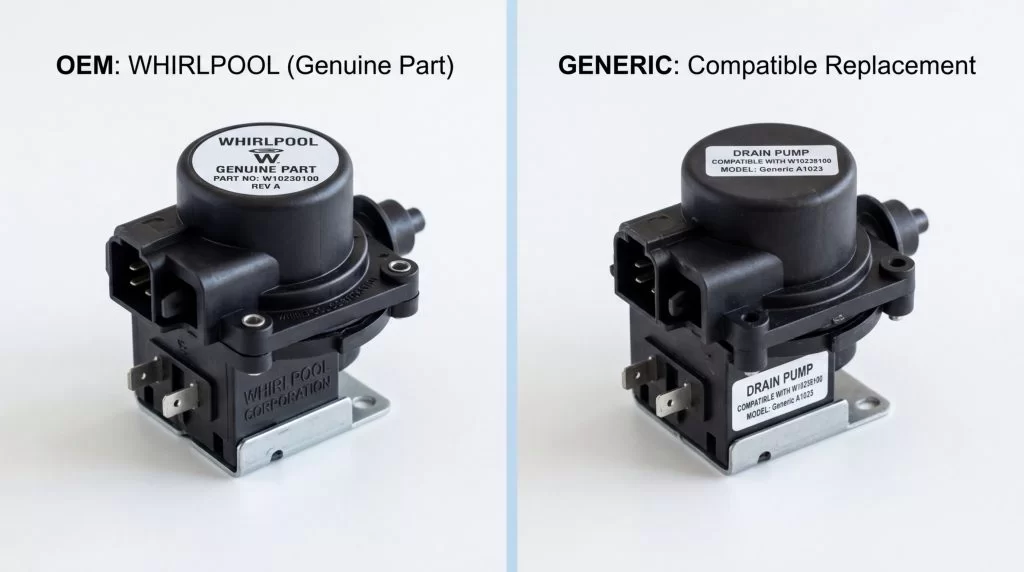
When your appliance needs a part, you will usually have two options: OEM (original equipment manufacturer) or aftermarket. OEM parts come from the same manufacturer as your appliance. Aftermarket parts are made by third-party companies and are designed to fit the same specifications. The price difference can be significant, sometimes 40 to 60 percent. But the two are not always equal. This guide explains when OEM is worth the premium and when aftermarket parts are a perfectly reasonable choice.
This is a question our technicians get often. The honest answer depends on which part and which appliance.
In this article
What OEM and aftermarket actually mean
OEM stands for original equipment manufacturer. For appliances, it means the part was made by or for the same brand as your machine: a Samsung drain pump ordered from Samsung, a Bosch door hinge sourced through Bosch, a Whirlpool control board from Whirlpool’s authorized distributor.
Aftermarket means the part was manufactured by a third party. Companies like Edgewater Parts, AP Parts, WPW, and Exact Fit make parts designed to fit a wide range of appliance models. Some are identical to OEM in function and durability. Others are made to a lower specification and priced accordingly.
Did you know?
Most OEM appliance parts are not actually manufactured in-house by the appliance brand. Samsung, LG, Whirlpool, and Bosch all source components from the same global supplier pool as aftermarket part makers. The difference is often quality control, specification tolerance, and warranty support, not a fundamentally different factory.
When to use OEM parts
For these categories, OEM is usually worth the premium:
- Compressors and sealed refrigeration systems. A compressor is the heart of a fridge or freezer. An aftermarket compressor that fails two years later costs more in total (two labour visits plus two parts) than the OEM would have cost up front. For high-end brands like Sub-Zero or Miele, OEM is non-negotiable.
- Control boards and inverter boards. The tolerance and programming on control boards are often tighter than aftermarket versions can match. A control board that does not communicate correctly with the rest of the machine will cause erratic behaviour, false error codes, and can damage other components.
- Door seals on high-end dishwashers. Bosch and Miele door seals are precision-fitted. Aftermarket seals sometimes do not compress correctly at the corner joints, leading to small leaks that are hard to diagnose.
- Anything still under manufacturer warranty. Using aftermarket parts may void the remaining warranty on your appliance. If the appliance is under warranty, use OEM.
When aftermarket parts are a reasonable choice
For simpler mechanical and electrical components, aftermarket parts from a reputable supplier are often a good call:
- Bake and broil elements for electric ovens. These are simple heating coils. The OEM and a quality aftermarket version heat to the same temperature and last about the same time. The price difference can be $40 to $80.
- Drum belts and drum rollers for dryers. Straightforward mechanical parts with simple specifications. A quality aftermarket belt for a Whirlpool or Samsung dryer performs identically to OEM in most cases.
- Water inlet valves (low-end brands). For washers and dishwashers from mainstream brands, aftermarket inlet valves from established suppliers are generally reliable.
- Drawer sliders, handles, and door pulls. Cosmetic and functional parts that do not affect performance. OEM is unnecessary.
- Light bulbs and filters. No quality advantage to OEM for these.
Pro tip
Always buy aftermarket parts from a supplier that includes a return policy and a warranty. Reputable Canadian suppliers include AppliancePartsPros.com (ships to Canada), PartSelect.ca, and PartsSelect.com. Avoid unnamed Chinese marketplace sellers for critical mechanical parts.
Aftermarket quality varies widely
The aftermarket parts market is split between professional-grade suppliers and low-cost alternatives. Here is a rough way to think about it:
| Tier | Typical sources | Quality | Best for |
|---|---|---|---|
| OEM | Manufacturer authorized distributors, brand websites | Guaranteed match to spec | Critical parts, warrantied appliances, high-end brands |
| Professional aftermarket | PartSelect, AppliancePartsPros, OEM Parts Online | Generally matches OEM performance | Common parts on mainstream brands |
| Budget aftermarket | Amazon third-party sellers, eBay, unbranded marketplace listings | Variable; often lower quality control | Cosmetic parts only; avoid for mechanical or electrical components |
How parts choice affects your warranty
If your appliance is still under the manufacturer warranty, using aftermarket parts will typically void the warranty for that component and potentially for the entire appliance. Most warranty terms specify that only authorized parts and authorized service technicians preserve coverage.
If your appliance is out of warranty, parts choice is entirely up to you and your technician. A reputable shop will discuss the tradeoffs with you and give you the option.
People often ask: Do technicians use aftermarket parts?
Reputable shops stock both OEM and aftermarket parts depending on the repair. For critical components (compressors, control boards), most good technicians prefer OEM. For common wear parts on mainstream brands, quality aftermarket is normal practice. If a shop always uses the cheapest aftermarket option without discussing it with you, ask why.
Cost comparison: OEM vs aftermarket
| Part | OEM cost (approx) | Aftermarket cost (approx) | Recommendation |
|---|---|---|---|
| Whirlpool dryer heating element | $55 to $80 | $25 to $45 | Aftermarket fine from reputable supplier |
| Samsung fridge water inlet valve | $65 to $100 | $30 to $55 | Aftermarket fine for mainstream models |
| Bosch dishwasher door seal | $80 to $140 | $40 to $70 | OEM recommended; fit tolerance matters |
| LG fridge compressor | $450 to $700 | $250 to $400 | OEM strongly recommended |
| KitchenAid oven control board | $200 to $380 | $120 to $200 | OEM recommended |
| Dryer drum belt (generic brand) | $15 to $25 | $8 to $15 | Quality aftermarket is fine |
| Fridge door handle | $30 to $80 | $15 to $40 | Either is fine; cosmetic only |
Frequently asked questions
Are aftermarket appliance parts as good as OEM?
For simple mechanical parts (belts, rollers, basic elements), quality aftermarket parts from reputable suppliers are generally comparable to OEM. For complex electronic components (control boards, inverter boards) and precision-fit parts (sealed system components, brand-specific door seals), OEM is usually the safer choice.
Will using aftermarket parts void my appliance warranty?
Yes, in most cases. Manufacturer warranties typically require authorized parts and authorized service. If your appliance is still under warranty, use OEM parts through an authorized technician.
Where can I buy OEM appliance parts in Metro Vancouver?
You can order OEM parts through brand-authorized distributors or directly from manufacturer websites. ASAP Appliance Repair sources both OEM and professional-grade aftermarket parts for repairs across Metro Vancouver. You can also order parts through our parts shop.
How do I know if an aftermarket part will fit my appliance?
Match the part number exactly. Every part has a manufacturer part number (usually printed on the old part or listed in the appliance’s service manual). A reputable parts supplier will confirm compatibility before you buy.
ASAP Appliance Repair uses quality parts on every job and discusses the OEM vs aftermarket tradeoff with you before proceeding. Book a service call for appliance repairs across all of Metro Vancouver.
Related repair services: Need a technician? We can help with appliance repair across Metro Vancouver.
 Fridge Repair
 Dishwasher
 Washer Repair
 Dryer
Dryer Oven Repair
 Stove Repair