


How to Clean a Dishwasher Filter (and Why Most People Never Do It)
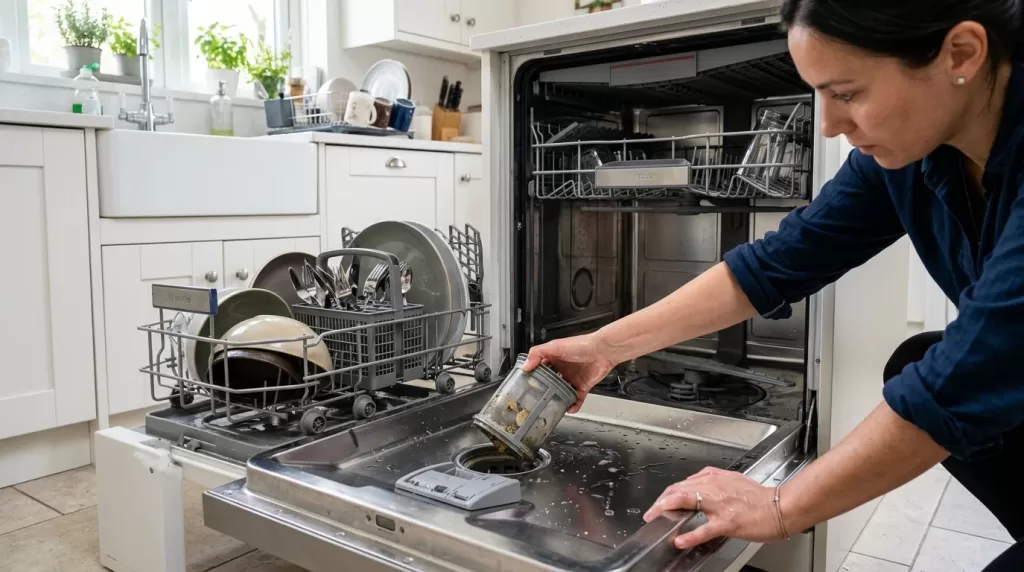
Cleaning a dishwasher filter is one of the most overlooked maintenance tasks in any kitchen. Most people never do it, and then wonder why dishes come out with grit on them or why the machine smells. Most dishwashers built in the last 15 years or so have a manual-clean filter that needs regular attention. This guide covers how to clean your dishwasher filter step by step, how often to do it, and the signs that tell you it is well past due.
The whole job takes about 5 minutes. It requires no tools and no special products.
In this article
Where to find your dishwasher filter
On most modern dishwashers, the filter assembly is at the bottom of the tub, usually in the centre or toward the back. It is often a two-piece assembly: a cylindrical upper filter and a flat lower mesh filter underneath it.
Remove the lower rack to access it. On some models (particularly older Bosch units), you will see a circular filter cap that you twist counterclockwise to remove. On others, there is a flat panel you lift out after removing the spray arm.
If you cannot find it: check your dishwasher manual. You can find most dishwasher manuals as a PDF by searching “[brand] [model number] owner manual” online. The model number is usually on a sticker inside the door frame.
Did you know?
Dishwashers before about 2010 had self-cleaning filters with a food grinder built in. Newer models switched to manual-clean filters because they are quieter. The tradeoff: you have to clean them yourself. Most people do not know this.
How to clean your dishwasher filter: step by step
- Remove the bottom rack. Set it aside to give yourself clear access to the filter.
- Remove the upper cylindrical filter. Grip it and rotate counterclockwise (usually a quarter turn) then lift straight up.
- Remove the flat lower filter. Lift it out from the bottom of the tub. On some models it clips in; on others it just sits in place.
- Rinse both pieces under warm running water. Hold the cylindrical filter and run water through it from the inside out to push debris out.
- Scrub with a soft brush. An old toothbrush works well. Work gently; do not use abrasive pads or brushes that could damage the mesh.
- Check the filter housing. Look into the hole where the filter sits and remove any food debris with a damp cloth or sponge.
- Reassemble. Put the flat filter back first, then seat the cylindrical filter and twist clockwise until it locks.
- Run a short hot cycle. This flushes any loosened debris out of the system.
Pro tip
A small bowl of white vinegar placed on the top rack during a hot cycle once a month helps dissolve mineral deposits and prevents odour. Do not use it together with a rinse aid or any other cleaning product in the same cycle.
How often to clean the dishwasher filter
The general guidance from most manufacturers is once a month for average household use. If you run the dishwasher daily or frequently wash heavily soiled dishes, clean it every two weeks.
If your household uses the dishwasher less often (a few times a week), every six to eight weeks is usually fine.
The problem with relying on a schedule alone: a filter can get heavily blocked from one batch of particularly gritty dishes. Trust the signs (next section) more than the calendar.
Signs your dishwasher filter needs cleaning right now
- Dishes coming out with grit or food particles. This is the clearest sign. The filter is not catching debris and it is recirculating through the wash cycle.
- Standing water in the bottom of the tub after a cycle. A blocked filter restricts drainage.
- Bad smell from the dishwasher. Trapped food debris in the filter rots. If the machine smells even after a hot cycle, the filter is almost always the culprit.
- Dishes not coming out clean despite a full cycle. If the filter is blocked, water pressure in the spray arms drops and washing performance suffers.
People often ask: Why does my dishwasher smell bad even after washing?
The most common reason is a dirty filter. Trapped food debris in the filter will produce an odour no matter how many cycles you run. Remove and clean the filter, then run a hot cycle with a bowl of white vinegar on the top rack.
Filter location and cleaning notes by brand
| Brand | Filter location | Removal method | Cleaning frequency |
|---|---|---|---|
| Bosch | Bottom centre, beneath lower spray arm | Remove spray arm first, then twist filter counterclockwise | Monthly |
| Miele | Bottom centre | Twist and lift; some models have a coarse pre-filter too | Every 2 to 4 weeks |
| LG | Bottom centre | Lift out flat filter first, then twist cylindrical filter | Monthly |
| Samsung | Bottom centre or rear corner | Twist to unlock; some models have a mesh cover over the drain | Monthly |
| KitchenAid | Bottom centre | Same as Whirlpool platform; twist and pull | Monthly |
| Whirlpool / Maytag | Bottom centre | Twist counterclockwise and lift | Monthly |
Frequently asked questions
How do I know if my dishwasher has a manual-clean filter?
Most dishwashers made after 2010 have a manual-clean filter. The easiest way to check: open the door, remove the bottom rack, and look at the bottom of the tub. If you see a cylindrical tube or a flat mesh panel that can be removed by hand, it is a manual-clean filter.
Can a dirty dishwasher filter damage the machine?
Yes. A severely blocked filter forces the pump to work harder and can cause premature pump failure. It also causes drainage issues that can result in water sitting in the tub between cycles and developing bacteria.
What can I use to clean a dishwasher filter?
Warm water and an old soft-bristled toothbrush is all you need. Avoid abrasive pads, wire brushes, or harsh chemicals that can damage the mesh. For mineral deposits, a brief soak in white vinegar loosens them.
My dishwasher is still not cleaning well after I cleaned the filter. What else should I check?
Check the spray arm holes for blockages. Small food particles can clog the spray arm jets and reduce washing pressure. Remove the spray arms (most unscrew or unclip), hold them under running water, and use a toothpick to clear any blocked holes. If cleaning the filter and spray arms does not solve it, the issue may be with the wash pump. If the problem persists, call for same day dishwasher repair service
If your dishwasher has a clean filter and is still not performing well, the issue may be with the spray arms, wash pump, or water inlet. Book a appliance diagnostic and we will identify the cause.
Related repair services: Need a technician? We can help with Dishwasher repair in Vancouver, Washer repair in Vancouver or appliance repair across Metro Vancouver.
 Fridge Repair
 Dishwasher
 Washer Repair
 Dryer
Dryer Oven Repair
 Stove Repair