


Why Is Your Wine Cooler Humming but Not Cooling?
A humming wine cooler that leaves your expensive bottles lukewarm is incredibly frustrating. That distinct noise is actually the first clue to solving the problem. When you notice a wine cooler not cooling but running, it means the unit is receiving power and at least one internal component is actively trying to work. If you need Professional refrigerator repair right away, a trained technician can diagnose the exact failure. Otherwise, understanding the mechanical sequence can help you figure out what is happening behind the glass door.
What it means when your wine cooler is not cooling but running
To understand why the temperature is rising, you have to look at how a wine fridge moves heat. These appliances do not actually create cold air. They remove heat from the interior cabinet and exhaust it into the room. This process relies on a sealed system containing chemical refrigerant, a compressor to pressurize that refrigerant, and a series of fans to circulate air.
When your wine cooler hums but fails to chill your collection, the sound confirms that electricity is flowing. You might hear the gentle whir of the interior circulation fan, which runs to keep the temperature even across all shelves. You might also hear the deeper hum of the condenser fan. However, the heavy lifting of the refrigeration cycle is not happening. The compressor might be offline, the refrigerant might be low, or the airflow might be completely blocked.
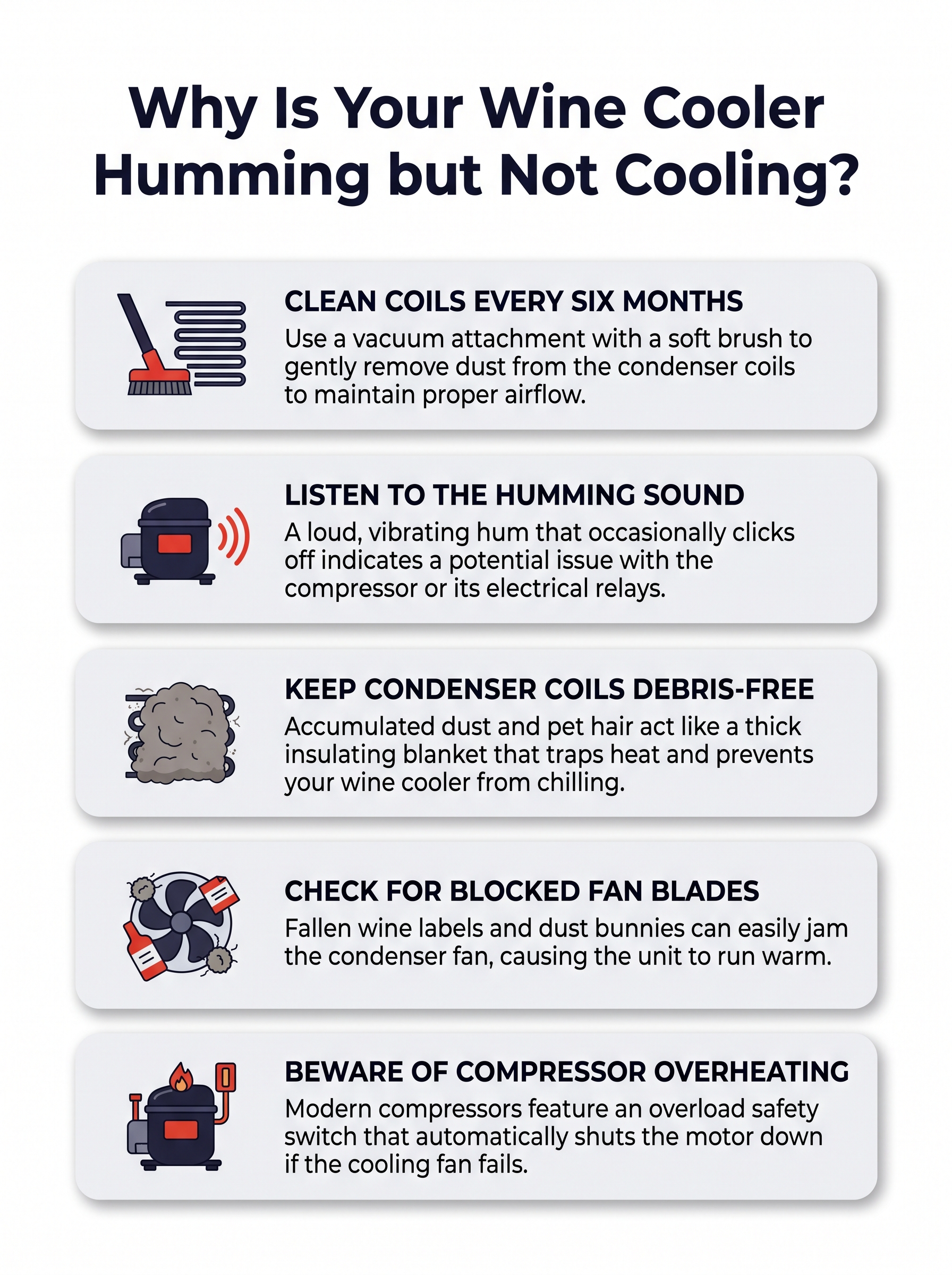
Identifying the source of the hum narrows down the list of suspects. A soft, continuous hum points toward fans. A louder, vibrating hum that occasionally clicks off points directly to the compressor and its electrical relays.
Dirty condenser coils are suffocating the system
Condenser coils act as the exhaust pipe for your wine cooler. As the compressor pumps hot, high-pressure refrigerant through these coils, they release the absorbed heat into the surrounding room air. They are usually located at the back of the unit or tucked underneath behind a kickplate.
Over time, these coils attract dust, pet hair, and airborne debris. This buildup acts like a thick insulating blanket. Instead of releasing heat, the coils trap it. The compressor is forced to run constantly to try and reach the target temperature, creating a continuous humming sound. Because the heat cannot escape, the internal temperature of the wine fridge remains stagnant or slowly rises.
Restoring airflow across the coils is often the easiest fix for a unit that runs non-stop without actually cooling down.
The condenser fan is blocked or failing
Most freestanding and built-in wine coolers use a dedicated condenser fan to blow room temperature air across the hot coils and the compressor. This fan is necessary to prevent the mechanical components from overheating.
If you notice the wine fridge fan running warm, a failing motor or a physical obstruction could be to blame. Dust bunnies, fallen labels, or debris can easily jam the fan blades. When the fan stops spinning at its full speed, the compressor loses its cooling breeze.
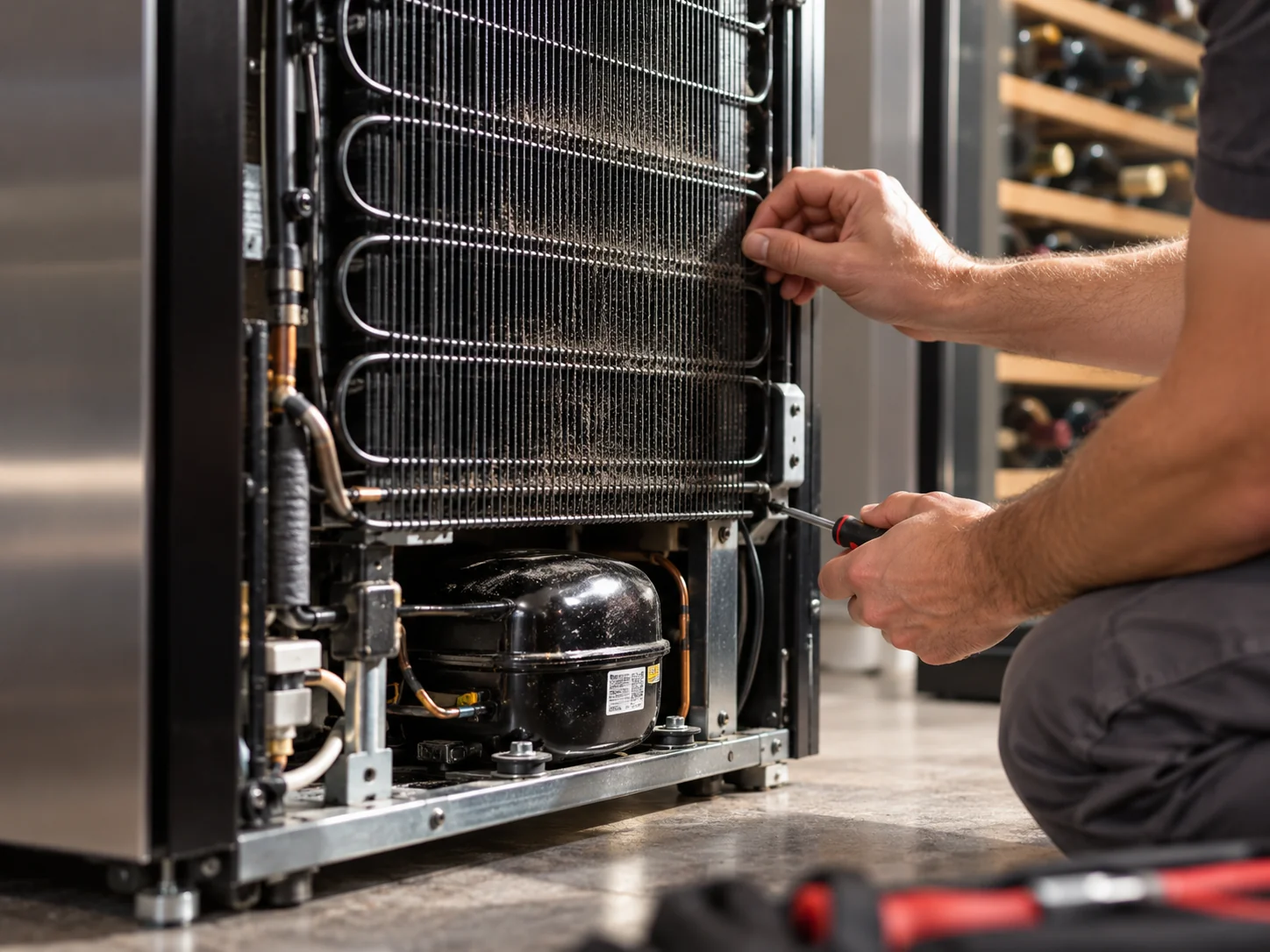
Without the fan, the compressor rapidly overheats. Modern compressors have an overload safety switch that shuts the motor down when it gets too hot. The circulation fans inside the cabinet will continue to hum, giving the illusion that the fridge is running, but the cooling cycle stops completely until the compressor cools down and resets.
A clicking or humming starter relay
The starter relay is a small electrical switch mounted directly to the side of the compressor. Its job is to deliver a massive, temporary power boost to jump-start the compressor motor.
These small components endure a lot of electrical stress and frequently wear out. When a starter relay fails, it often produces a distinct clicking sound followed by a continuous wine cooler humming noise. You will hear a “click,” a brief hum as the compressor tries to draw power, and then another “click” as the overload switch trips to prevent an electrical fire.
Relays are relatively inexpensive parts, but diagnosing them requires opening the electrical housing on the side of the compressor. A technician will look for scorch marks, rattling sounds when the relay is shaken, or a lack of electrical continuity. Because this involves live voltage and delicate compressor pins, testing requires a multimeter and is best left to an appliance technician.
Thermostat failures and beverage fridge temperature fluctuation
The thermostat acts as the brain of your wine cooler. It constantly monitors the air inside the cabinet and sends voltage to the compressor when the temperature rises above your set point.
If the temperature sensor breaks or falls out of calibration, it fails to read the internal environment correctly. The thermostat might register that the cabinet is perfectly chilled at 55 degrees, even when it is actually 75 degrees inside.
This mechanical disconnect causes the system to run the interior fans continuously without ever signaling the compressor to turn on. The result is severe beverage fridge temperature fluctuation and a constant humming noise with zero actual cooling power. Dual-zone wine coolers rely on multiple sensors and a main control board to manage different temperature requirements for red and white wines. A failure in these controls can cause one zone to run warm while the fans hum continuously.
Evaporator issues and hidden frost buildup
The evaporator coil sits inside the main cabinet behind a rear panel. As cold refrigerant flows through this coil, a fan blows air across it, chilling the interior of the wine cooler.
These coils naturally accumulate a small amount of frost, which the appliance manages through an automatic defrost cycle. If the defrost heater or timer fails, that frost turns into a solid block of ice. This ice literally insulates the evaporator coils, preventing them from absorbing heat from the cabinet.
The internal fans will continue to hum in the background, trying to circulate air, but the solid ice blocks the cold air from reaching your wine bottles.
If you suspect a frozen evaporator, unplug the unit and leave the door open for 24 hours to let the ice melt naturally before turning it back on. If it freezes up again a few days later, the defrost system needs professional repair.
When to schedule professional wine cooler repair
Troubleshooting a warm wine fridge requires a logical approach. Cleaning dirty coils, checking for blocked fans, and letting a frozen unit thaw are all safe steps you can take at home. However, any electrical testing or sealed system work requires professional certification.
Wine collections degrade quickly in warm environments. Heat damage causes premature aging, expands the liquid to push past the corks, and permanently spoils the flavor profile of expensive bottles. Acting quickly is the best way to protect your investment.
If basic maintenance does not restore the proper temperature, it is time to Get a free estimate for expert diagnostics. A technician can test the relays, check the refrigerant pressure, and replace faulty thermostats safely.
Frequently asked questions about humming wine coolers
Why is my wine cooler making a loud vibrating noise?
Loud vibrations often point to an unlevel cabinet. If the cooler is not sitting flat on the floor, the metal panels will rattle against each other. Vibrations can also come from worn rubber isolation mounts under the compressor. As these rubber feet harden and crack over time, the natural vibration of the compressor transfers directly into the appliance frame.
How much ventilation does a freestanding wine cooler need?
Adequate airflow is important for efficiency. According to ENERGY STAR guidelines, appliances need room to breathe to operate efficiently. Freestanding units typically need at least two to three inches of clearance on all sides and the top. Pushing a freestanding cooler tight against a wall or installing it under a counter traps heat, forcing the system to run constantly and creating a permanent humming noise.
Can a low refrigerant leak cause a humming sound?
Yes. If microscopic pinhole leaks allow the refrigerant gas to escape, the system loses its ability to move heat. The thermostat will notice the cabinet is too warm and command the compressor to run. Because there is not enough refrigerant to actually drop the temperature, the compressor will run non-stop trying to compensate. This creates a constant, unbroken hum until the compressor eventually burns out from overwork.
Frequently Asked Questions
Why is my wine cooler making a humming noise but not getting cold?
A humming noise indicates your wine cooler is receiving power. The sound typically comes from the internal circulation fans or the condenser fan. If the unit is not getting cold, the cooling cycle is failing. This is often caused by dirty condenser coils, a jammed fan, or a faulty compressor starter relay preventing the system from removing heat.
How often should I clean the condenser coils on my wine fridge?
You should clean the condenser coils on your wine cooler every six months. These coils act as the exhaust system for the appliance. When they become coated in dust or pet hair, they trap heat instead of releasing it. Regular cleaning with a soft vacuum brush attachment maintains proper airflow and prevents the compressor from overheating.
What does it mean if my wine cooler clicks and then hums?
A clicking sound followed by a brief hum usually points to a failed starter relay. This small electrical switch provides the initial power boost to start the compressor motor. When the relay fails, the compressor tries to draw power, hums briefly, and then triggers an overload safety switch with a loud click to prevent electrical damage.
Why are the fans inside my wine cooler running but the temperature is rising?
Internal fans often run continuously to circulate air and maintain an even temperature across all shelves. If these fans are spinning but the internal temperature is rising, the compressor is likely offline. This happens when the compressor overheats due to a blocked external condenser fan or when a safety switch cuts power to the cooling system.
Can a broken thermostat stop a wine cooler from cooling?
Yes, a malfunctioning thermostat can completely stop your wine cooler from cooling. The thermostat monitors the internal cabinet temperature and signals the compressor to turn on when the air gets too warm. If this sensor fails, it will not send the required voltage to the compressor, leaving the internal fans to run while the bottles slowly reach room temperature.
Free Checklist: Wine Cooler Humming But Not Cooling Guide
 Fridge Repair
 Dishwasher
 Washer Repair
 Dryer
 Oven Repair
 Stove Repair